High performance Liquid chromatography(HPLC)


1.     Introduction
High-Performance Liquid Chromatography(HPLC: formerly referrd to ashigh-pressour liquid Chrometography), is a techique in analytical chemistry used to separate, identify, and quantify each component in a mixture.
The principle of chrometography, in chromatography a liquid is pumped through a bed of particles. The liquid is called the mobile phase and the particle the staionary phase . High performance liquid chrometography high performance liquid chrometography (HPLC) is basicallly a highy improved from liquid chrometography. Instead of solvent being chrometograhy allowed todrip though a column under gravity, it is forced through under high pressur of up to 400 atmospheres.That makes it much faster. All chrometograhy separation , includinHPLC operate under the sane basic principle; sepration of a samll into it’s  constituent parts because of the difference in the relative affinities of defferent molecules for the mobile phase and the stationary phase used in the sepration.
2.     Instrumentation of  HPLC


3.     HPLC Tuoubleshooting
A.   Peak Tailing
Possible Cause
Solution
1.     Blocked frit
1.      
a.     Reverse flush column ( if allowed)
b.     Replace inlet frit
c.      Replace Column

2.     Column Void
2.     Fill void
     3.  Interfering peak  
     3. 
               a.  Use longer column
               b. Change mobile phase                 and / or column/ selectivity
     4.Wrong mobile phase pH
     4.
              a. Adjust pH
              b. For basic compounds,  lower pH usually provide more symmetric peak.
4.     Sample reacting with active site
5.      
a.     Add ion pair reagent or volatile basic modifier
b.     Change column


B.   Peak Pronting


Possible Cause
Solution
1.     Low temperature
1.Increase cloumn temerature
2.     Wrong sample solvent
2.Use mobile phase for injection solvent
3.     Sample overload
3.Decrase sample concentration
4.     Bad Column
4.See A.1 and A.2

C.   Split Peaks


Possible Cause
Solution
1.     Contamination on guard or analytical column inlet
          Fig. Split Peaks


         1.
              a.Remove guard column and attempt analysis.
              b.Replace guard if necessary
              c.If analytical column is obstructed, reverse and flush
             d.If problam persists, column may be fouled with strongly reatined contaminats
             e.Use appropriate restration procedure
             f.If problam persists, inlet is probably plugged
            g.Change frit or replace column
2.     Sample solvent incompatible with mobile phase
2.Change solvent; whenever possible, inject samples in mobile phase


D.   Distortion of Larger peaks


Possible Cause
Solution
1.     Sample overload
1.Reduce sample size


E.   Distoration of Early Peaks

Possible Cause
Solution
1.     Wrong injection
1.
a. Reduce injection volume
b. Use weaker injection solvent


F.    Extra peaks

Possible Cause
Solution
1.     Other components in sample
1.Normal
2.     Late- eluting peak from previous injection
2.
a. Increase run time or gradient slope
b. Increase flow rate
3.     Vacancy or ghost peaks
3.
a. cheak purity of mobile phase
b. Use mobile phase as injection solvent
c. Reduce injection volume


G.  Retention Time Drifts

Possible Cause
Solution
1.     Poor temperature control
1.Thermotat column
2.     Mobile phase changing
2.Prevent change (evaporation, reaction.)


H.  Abrupt Retention Time Change

Possible Cause
Solution
1.     Flow rate change
 1.Reset flow rate
2.     Air bubble in pump
 2.Bleed air from pump
3.     Improper mobile phase
      3.
      a. Replace with proper mobile phase
          b.Set proper mobile phase mixture on
4.     Weak detectour lamp
       4.Replace lamp
5.     Column leaking silica or packing material
       5.Replace Column
6.     Mobile phase mixture inadequate or malfunctioning
7.     Repair or replace the mix offline if isocratic


I.      Broad Peaks

Possible Cause
Solution
1.     Mobile phase composition changed
1.Prepare new mobile phase
2.     Mobile-phase flow rate too low
           2.Adjust flow rate
3.     Leaks
           3.
         a. See Section 3
         b. Cheak for loose fittings
         c. Cheak pump for leaks, salt build- up , and unsual noises
         d. Change seals if necessary
4.     Detector setting incorrect
           4.Adjust setting
5.     Extra-column effect:
a.     Column overloaded
b.     Detectore response time oe call volume too large
c.      Tubing between column and dectector too long or ID too larg
d.     Recorder response time too high
           5.
a.     Inject smaller column (e.g. 10µl vs. 100 µl) or 1:100 and 1:100 dilution of sample
b.     Reduce response time oe use smaller call
c.      Use as short a piece of 0.007-0..10. inch ID tubing as practical
d.     Reduce respose time

6.     Buffer concentration too low
6.Increase concentration
7.     Guard column contaminated / worn out
           7.Replace guard colunm
8.     Column contaminateds / worn out: low plate number

9.     Void at column inlet


Comming Soon............................

Drx. Atul Jaiswal , Sourabh Kushwah
 and Vishal Kushwah

Cell Division-Mitosis and Meiosis


Cells divide for many reasons. For example, when you skin your knee, cells divide to replace old, dead, or damaged cells. Cells also divide so living things can grow. When organisms grow, it isn't because cells are getting larger. Organisms grow because cells are dividing to produce more and more cells. In human bodies, nearly two trillion cells divide every day.


Mitosis Cell Division
Mitosis is how somatic—or non-reproductive cells—divide. Somatic cells make up most of your body's tissues and organs, including skin, muscles, lungs, gut, and hair cells. Reproductive cells (like eggs) are not somatic cells.
In mitosis, the important thing to remember is that the daughter cells each have the same chromosomes and DNA as the parent cell. The daughter cells from mitosis are called diploid cells. Diploid cells have two complete sets of chromosomes.  Since the daughter cells have exact copies of their parent cell's DNA, no genetic diversity is created through mitosis in normal healthy cells. 


Mitosis cell division creates two genetically identical daughter diploid cells. The major steps of mitosis are shown here. (Image by Mysid from Science Primer and National Center for Biotechnology Information)

The Mitosis Cell Cycle

Before a cell starts dividing, it is in the "Interphase." It seems that cells must be constantly dividing (remember there are 2 trillion cell divisions in your body every day), but each cell actually spends most of its time in the interphase. Interphase is the period when a cell is getting ready to divide and start the cell cycle. During this time, cells are gathering nutrients and energy. The parent cell is also making a copy of its DNA to share equally between the two daughter cells.

Table- The mitosis cell cycle includes several phases that result in two new diploid daughter cells. Each phase is highlighted here and shown by light microscopy with fluorescence. Click on the image to learn more about each phase. (Image from OpenStax College with modified work by Mariana Ruiz Villareal, Roy van Heesheen, and the Wadsworth Center.)
The mitosis division process has several steps or phases of the cell cycle—interphase, prophase, prometaphase, metaphase, anaphase, telophase, and cytokinesis—to successfully make the new diploid cells
.
When a cell divides during mitosis, some organelles are divided between the two daughter cells. For example, mitochondria are capable of growing and dividing during the interphase, so the daughter cells each have enough mitochondria.  The Golgi apparatus, however, breaks down before mitosis and reassembles in each of the new daughter cells. Many of the specifics about what happens to organelles before, during and after cell division are currently being researched. (You can read more about cell parts and organelles by .)

Meiosis Cell Division 

Meiosis is the other main way cells divide. Meiosis is cell division that creates sex cells, like female egg cells or male sperm cells.  What is important to remember about meiosis? In meiosis, each new cell contains a unique set of genetic information. After meiosis, the sperm and egg cells can join to create a new organism.    

Meiosis is why we have genetic diversity in all sexually reproducing organisms. During meiosis, a small portion of each chromosome breaks off and reattaches to another chromosome. This process is called "crossing over" or "genetic recombination." Genetic recombination is the reason full siblings made from egg and sperm cells from the same two parents can look very different from one another. 

The Meiosis Cell Cycle

Meiosis has two cycles of cell division, conveniently called Meiosis I and Meiosis II. Meiosis I halves the number of chromosomes and is also when crossing over happens. Meiosis II halves the amount of genetic information in each chromosome of each cell. The end result is four daughter cells called haploid cells. Haploid cells only have one set of chromosomes - half the number of chromosomes as the parent cell.
Before meiosis I starts, the cell goes through interphase. Just like in mitosis, the parent cell uses this time to prepare for cell division by gathering nutrients and energy and making a copy of its DNA. During the next stages of meiosis, this DNA will be switched around during genetic recombination and then divided between four haploid cells. 
By Atul Jaiswal

Multidisciplinary Nature of Environmental Studies

Solar System (Solar System) of the nine planets Earth is the only planet where life is found. Here's environmental conditions suitable for life-processes to operate is found. This feature of the Earth 'Sun distance is an important role. Earth, Mercury, Venus and Tue-like planets is not hot, nor Jupiter-like gaseous planet such as nor be more cool is Varuna and Yama. Oxygen in the atmosphere is found here, which is absolutely necessary for the survival of all organisms. The Earth's atmosphere prevents Bhusath more warm and keeps its temperature control. The seasons are not so much difference in the temperature of the earth is found. Who is present here on earth abundant water maintains the temperature of the damp. For these reasons, the fauna and flora living here and their Jivniy conduct activities that are bucking the inheritance. Earth is not uniform at all locations, so there is much more cold than heat, more drought, if there is more rain, even if the mountain plateaus, plains far, far more so than aridity abundant water is available . For example, the Earth's poles in extreme cold environments penguins, walruses are found in fish and some other animals such as the polar bear, and are also found in such environments.

Our solar system

Our planet (Planet) that our Earth is a celestial body orbiting the Sun on its orbit is elliptical. Of any planet would not give her light. Because they reflect the sun's rays shine.

Different planet wires (Stars) are closer to the Earth than, so they look great then, but do not appear to twinkle. These planets from west to east, so their location varies daily. A total of nine planets of our solar system the Earth from the Sun, which are kept in order to grow. The first four of these planets planets - Mercury, Venus, Earth and the inner planets and subsequent Tue four planets - Jupiter, Saturn, Uranus (Arun) and Neptune (Neptune) is called the outer planets. The structure of the inner planets, including the earth, while the outer planets formed from hydrogen and helium gases is. In the more distant ninth planet Plato (Yama) Cai, like the inner planets are thought to be dense and larger in all the planets orbit. Sun and its neighboring stars to 250 km on a circular track. The average speed per second Way (Galaxy) is the center of the live round. The speed of twenty-five million years to complete one revolution takes sun, the universe is called the year.

Our Sun

14.38 million km of the Sun's distance from the earth. (Minimum). Its diameter (Diameter) 1362000 km. is. The estimated temperature of the interior of 1,50,00000. 
(Rs five million Kelvin) temperature and Diptman 6000 level. (The equivalent of a Kelvin - 2730 Segre.). Sun Chemical Sncrcna 71 percent hydrogen, helium and other elements from 26.5 to 2.5 percent. An estimated ten billion years of age, of which it has already spent almost five billion years of age. The average distance of 15.6 million km of the Sun from the Earth. If the flight hours to be converted at the rate of 1000 per hour Kimin Flying a jet plane it will take 17 years to complete the journey. Sun Radius (Radius) about 1000 times the Earth's radius and its magnitude is a million times.

The new member of the solar system - "Sedena"


Members of the solar system has added another member's name - "Sedena", which I have only a few days ago. Just looking at the new members continues. Therefore, it is difficult to say that about Sedena planet or object. But it can be said that a relative of the planet Tue, Tue since because it is the second member whose color is red. Sedena in space, which is located in the part with full dark - even with extremely cold. It is known that Sedena is located far away from the sun. Being away from the sun as the temperature around minus 38 degrees centigrade in less than a hundred.

Sedena distance from the sun nearly 2 billion 37 million years (3.65 million days) imposes time. The Sedena is a moon orbiting its remains. However Sedena was not just about information, but it definitely has been a subject of curiosity for the mysterious nature. Pluton is considered the solar system's smallest member, Sedena broke the record of his having been the smallest. The diameter of our Moon is about half the 11 hundred miles, while the diameter of the moon is approximately 21 hundred miles. Similarly, three hundred miles from the Pluton short. Sedena orbit the sun is huge and full of icy clouds. It is located at a remote location where the member was not even imagine having. Somewhat shiny surface of the planet of the solar system, comets may be native to the region, because the region is the birth of comets. Its historic name "Sedena" In accordance with the new member of the Board is not less mysterious.

Our Earth


Based on the study of the rocks of the Earth around 4600 million years of age has been underestimated. The entire area of ​​about 51 million sq km outer. 
While about 15 million sq km of terrestrial surface. is. The water surface area of ​​about 36 million sq km. is. 40037 km circumference of the earth at the equator. And 40,000 km on the polar line. is. 12754 km in diameter at the equator. And 6377 km radius. Has been underestimated. Its average distance from the Sun, about 14 crore 94 lakh 7 thousand km. is. The orbital period of 23 hours 56 minutes 4.09 seconds on its axis and around the sun 365 days 5 hours 48 minutes 45.51 seconds during cruises. 230 on its axis 27 'is inclined ....

Coming Soon.......................

By Anshul Kushwah and 
Devendra kushwah


Responsibilities for Medical Representative


In any setting, the process of selling involves contacting 
potential customers, identifying their needs, persuading 
them that your products or services (rather than those of competitors) can best satisfy those needs; closing the sale by agreeing the terms and conditions; and providing an after-sales service. As a medical sales representative, you'll do all of this and more.

Duties often include:
  • arranging appointments with doctors, pharmacists and hospital medical teams, which may include pre-arranged appointments or regular 'cold' calling;
  • making presentations to doctors, practice staff and nurses in GP surgeries, hospital doctors and pharmacists in the retail sector. Presentations may take place in medical settings during the day, or may be conducted in the evenings at a local hotel or conference venue;
  • organising conferences for doctors and other medical staff;
  • building and maintaining positive working relationships with medical staff and supporting administrative staff;
  • managing budgets (for catering, outside speakers, conferences, hospitality, etc.);
  • keeping detailed records of all contacts;
  • reaching (and if possible exceeding) annual sales targets;
  • planning work schedules and weekly and monthly timetables. This may involve working with the area sales team or discussing future targets with the area sales manager. Generally, medical sales executives have their own regional area of responsibility and plan how and when to target health professions;
  • regularly attending company meetings, technical data presentations and briefings;
  • keeping up to date with the latest clinical data supplied by the company, and interpreting, presenting and discussing this data with health professionals during presentations;
  • monitoring competitor activity and competitors' products;
  • maintaining knowledge of new developments in the National Health Service (NHS), anticipating potential negative and positive impacts on the business and adapting strategy accordingly;
  • developing strategies for increasing opportunities to meet and talk to contacts in the medical and healthcare sector;
  • staying informed about the activities of health services in a particular area.

Working hours

Working hours typically include regular extra hours, but not weekends or shifts.
Work is generally office or home based but a substantial amount of time is spent travelling to and from clients.
Self-employment and freelance work is uncommon. The prospects for re-employment after a career break are good. Part-time work is also possible.

What to expect
  • Opportunities occur throughout the UK, but the job usually involves responsibility for a particular geographical area. If you're successful, you may find yourself head-hunted from one company or region to another.
  • Smart dress and a professional appearance are essential.
  • There is a lot of travel during the day with occasional absence from home overnight. You may have to attend client dinners on some evenings.
  • Overseas work is uncommon.

Qualifications
Although this career is open to all graduates, the following subjects may improve your chances:
  • dentistry;
  • life sciences;
  • medicine;
  • nursing;
  • pharmacy.
A business or marketing degree may also be helpful, especially if accompanied by some knowledge of medical sales and what this involves.
Entry with a HND or foundation degree is possible as training is given. Life science or healthcare subjects are particularly useful.
A pre-entry postgraduate qualification is not necessary, although a relevant Masters can be an advantage for medical sales positions requiring specific, technical knowledge.
If you do not have a science or healthcare-related qualification, a background in business or sales is important.

Skills
You will need to show:
  • excellent communication skills;
  • an outgoing and persuasive manner and the ability to deal with people who hold differing beliefs or values;
  • confidence and persistence;
  • patience and self-motivation;
  • analytical and planning skills;
  • a flexible approach to work in order to adapt to changes, for example in the healthcare system or product and drug formularies;
  • strong teamwork and networking skills;
  • commercial and business awareness.
 By Mohit Motiwale 
and Akhilesh Mewade

Role and Responsibilities for Quality Assurance managers


Qualification:-  B.Pharmacy    , M.Pharma. 


Role & Responsibilities:-

  • Draft quality assurance policies and procedures.
  • Interpret and implement quality assurance standards.
  • Evaluate adequacy of quality assurance standards.
  • Devise sampling procedures and directions for recording and reporting quality data.
  • Review the implementation and efficiency of quality and inspection systems.
  • Plan, conduct and monitor testing and inspection of materials and products to ensure finished product quality.
  • Document internal audits and other quality assurance activities.
  • Investigate customer complaints and non-conformance issues.
  • Collect and compile statistical quality data.
  • Analyze data to identify areas for improvement in the quality system.
  • Develop, recommend and monitor corrective and preventive actions.
  • Prepare reports to communicate outcomes of quality activities.
  • Identify training needs and organize training interventions to meet quality standards.
  • Coordinate and support on-site audits conducted by external providers.
  • Evaluate audit findings and implement appropriate corrective actions.
  • Monitor risk management activities.
  • Responsible for document management systems.
  • Assure ongoing compliance with quality and industry regulatory requirements.
Skills:-

Good Communication Skills verbal & written.


Drx. Lalit Kushwah

Chromatography and it's types

Chromatography

Chromatography is usually introduced as a technique for separating and/or identifying the components in a mixture. The basic principle is that components in a mixture have different tendencies to adsorb onto a surface or dissolve in a solvent. It is a powerful method in industry, where it is used on a large scale to separate and purify the intermediates and products in various syntheses.

Different types of chromatography:-

1.     Thin layer chromatography (TLC)
2.     Gas chromatography (GC)
3.     Liquid chromatography (LC)
4.     High performance liquid chromatography (HPLC)
5.     Ion exchange chromatography
6.     Gel permeation or Gel filtration chromatography.

Principles
Chromatographic methods require one static part (stationary phase) and one moving part (mobile phase). The techniques rely on one of the following phenomena: adsorption; partition; ion exchange; or molecular exclusion.

1.     Adsorption
Adsorption chromatography was developed first. It has a solid stationary phase and a liquid or gaseous mobile phase. (Plant pigments were separated at the turn of the 20th century by using a calcium carbonate stationary phase and a liquid hydrocarbon mobile phase. The different solutes travelled different distances through the solid, carried along by the solvent.) Each solute has its own equilibrium between adsorption onto the surface of the solid and solubility in the solvent, the least soluble or best adsorbed ones travel more slowly. The result is a separation into bands containing different solutes. Liquid chromatography using a column containing silica gel or alumina is an example of adsorption chromatography.(Fig.1 or 1.1)
The solvent that is put into a column is called the eluent, and the liquid that flows
out of the end of the column is called the eluate.

 Fig. 1 Adsorption Chromatography

                               Fig.1.1 Adsorption Chromatography
2.     Partition
In partition chromatography the stationary phase is a non-volatile liquid which is held as a thin layer (or film) on the surface of an inert solid. The mixture to be separated is carried by a gas or a liquid as the mobile phase. The solutes distribute themselves between the moving and the stationary phases, with the more soluble component in the mobile phase reaching the end of the chromatography column first. Paper chromatography is an example of partition chromatography.(Fig.2)
 Fig.2 Partition Chromatography

3.     Ion exchange
Ion exchange chromatography is similar to partition chromatography in that it has a
coated solid as the stationary phase. The coating is referred to as a resin, and has ions
(either cations or anions, depending on the resin) covalently bonded to it and ions of
the opposite charge are electrostatically bound to the surface. When the mobile phase (always a liquid) is eluted through the resin the electrostatically bound ions are released as other ions are bonded preferentially. Domestic water softeners work on this principle.(Fig.3)

Fig. Ion exchange Chromatography

4.     Molecular exclusion

Molecular exclusion differs from other types of chromatography in that no equilibrium state is established between the solute and the stationary phase. Instead, the mixture passes as a gas or a liquid through a porous gel. The pore size is designed to allow the large solute particles to pass through uninhibited. The small particles, however, permeate the gel and are slowed down so the smaller the particles, the longer it takes for them to get through the column. Thus separation is according to particle size.

By Anshul Kushwah

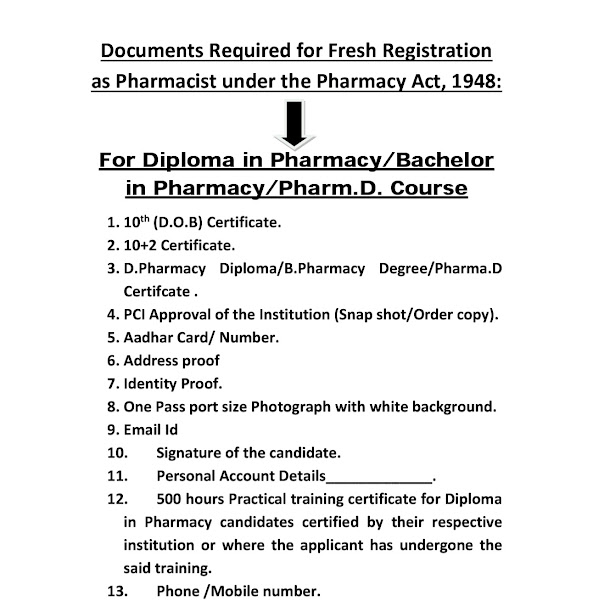
Documents Required for Fresh registration as pharmacist

          14. 3200/- for online registration charge.